 CRE
CRE Commercial Real Estate AI Automation Training Plan

The gap isn’t tools anymore — it’s readiness
As of 2026, the constraint on AI in brokerage isn’t model quality. It’s that the people who own the workflows haven’t been trained to redesign them.
Two industry signals point the same direction. Both come from the 2025 wave of agentic-AI coverage — check the dateline on each before you quote it internally. Deloitte’s press release on its enterprise AI-readiness survey is framed around a single question in its own headline: whether organizations are ready for agentic AI. Its argument is that the differentiator is readiness — governance, data foundations, workforce capability — rather than which model you pick. The release also carries specific survey percentages; open it and read those figures at the source rather than taking our paraphrase into a board deck. In residential brokerage, HousingWire’s coverage of The Real Brokerage’s Leo assistant is equally literal in its headline: the next phase is “replacing the work, not the agent” — routine task work around a transaction gets handed over, the licensee doesn’t. Both framings put the burden on the firm: someone has to decide which work gets handed over, and teach people how to hand it over safely.
That is a training problem. Searches for a “commercial real estate AI automation course” usually reflect it — but a generic course won’t teach your team your listing conventions, your CRM fields, or your commission structure. The curriculum below assumes you build it internally around one real workflow.
The three literacies your team actually needs
Most brokerage AI training stops at literacy one and wonders why nothing changed.
1. Prompting and judgment. Writing a useful request, giving the assistant the right source documents, and — critically — knowing what a wrong answer looks like. A broker who can’t spot a hallucinated escalation clause shouldn’t be shipping AI-drafted abstracts to a client.
2. Skills — packaged, repeatable instructions. A skill is a reusable set of instructions that teaches an assistant to do one job the same way every time: your property flyer voice, your tour follow-up sequence, your LOI summary format. Instead of every broker re-prompting from scratch, the firm’s standard lives in one place and gets versioned.
3. Agents and connected systems. An agent carries out multi-step tasks and takes actions — reads the email thread, updates the deal stage in the CRM, files the executed document, drafts the next follow-up. Connecting an assistant like Claude to your systems is usually done through MCP (Model Context Protocol), an open standard for giving an AI governed access to specific tools and data. The mechanics are in our walkthrough on connecting Claude to brokerage systems via MCP.
Teaching prompting without teaching supervision produces confident brokers sending unreviewed work to clients. That is worse than no training at all.
A four-week rollout you can run internally
-
Week 1 — Pick one workflow and baseline it by hand
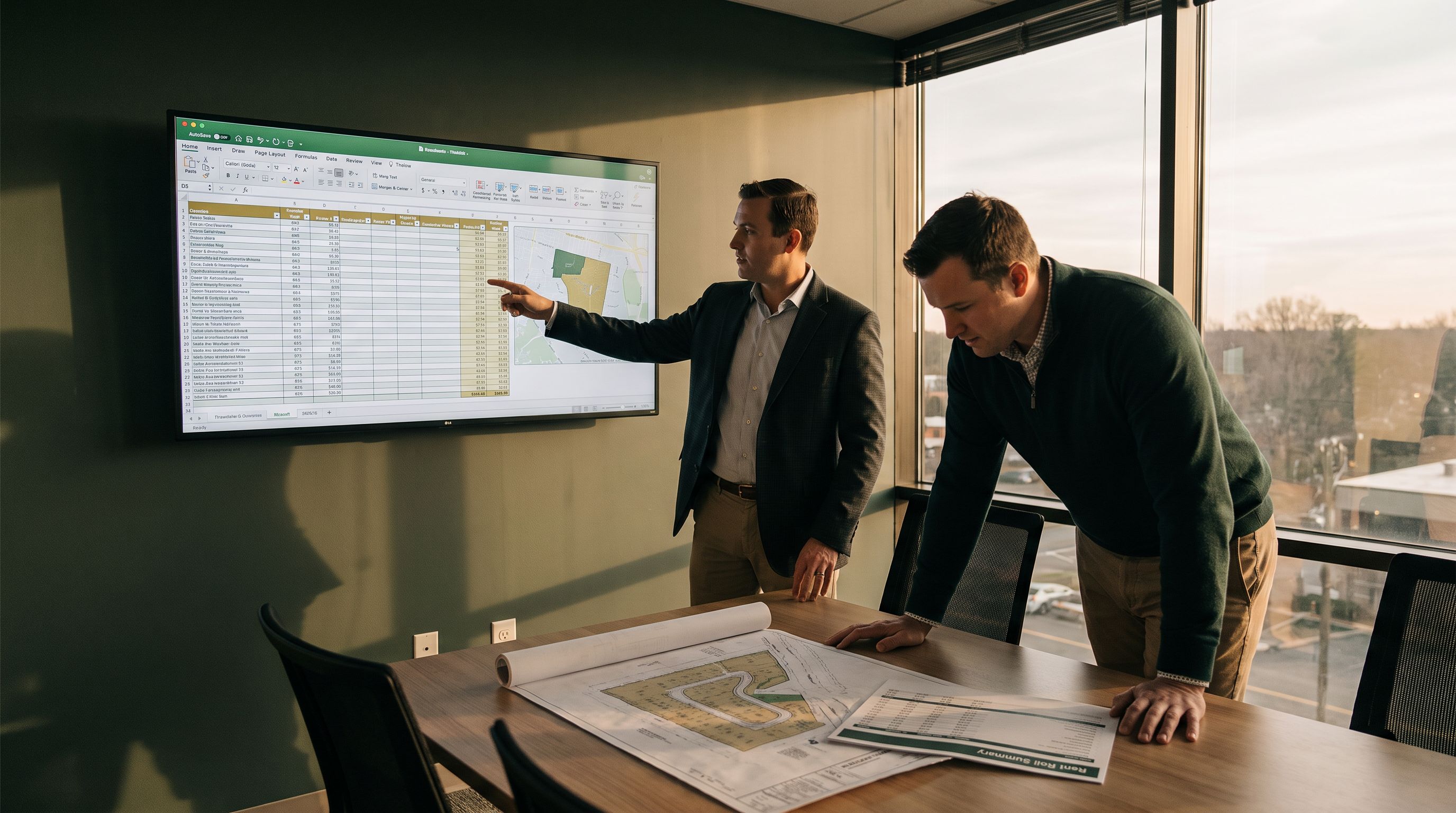
Choose a workflow that is high-frequency, low-ambiguity, and internally owned. Good candidates: rent roll abstraction, listing inquiry triage, tour follow-up, deal-file checklist review. Before touching AI, have the ops team time the current process and write down every step, input, and output. You cannot evaluate automation against a process you never measured.
-
Week 2 — Everyday-user module (90 minutes, all staff)
Hands-on, on real (redacted) deal material: uploading a lease and asking targeted questions, drafting from a template, checking outputs against source pages. Cover data handling explicitly — which documents may be pasted into which tool, and which client materials are covered by NDA. Assume mixed comfort with software and mixed language backgrounds on your team: publish a written step-by-step with screenshots alongside the live session, and offer a slower repeat run people can opt into without asking permission. End with one house rule everyone can repeat: the assistant drafts, a named human signs.
-
Week 3 — Workflow-owner module (half day, ops + one broker champion)
This smaller group writes the firm’s first skill for the Week 1 workflow: the exact instructions, the required output format, the fields it must never guess. Then they define the review gate — what a human checks before anything leaves the building or writes to the CRM. Version it in a shared location, not in someone’s chat history.
-
Week 4 — Connect one system, read-only first
Give the assistant scoped access to one system — usually the CRM or the document store — and start read-only. Let it answer portfolio questions and draft updates before it writes anything. Log every call. Only after the read-only phase looks boring do you enable write actions, and even then start with reversible ones (creating a draft, adding a note) before irreversible ones (sending email, changing stage).
-
Ongoing — a monthly 30-minute review
One standing meeting: what did the agent get wrong, which skill needs an edit, what’s the next workflow. Skills rot when your listing templates or CRM fields change and nobody updates the instructions.
Matching tools to jobs
The most common question — which AI tool is best for commercial real estate — has no single answer, and anyone who gives you one is selling something. The honest framing is by job:
- Data and comps: the platform you already license (CoStar, Crexi, Reonomy and peers) usually wins, because the value is the data, not the AI layer.
- Marketing and deal collateral: your CRE CRM’s built-in generation (Buildout, Apto and similar) is often good enough and requires no build.
- Document-heavy reasoning — lease abstraction, OM drafting, deal-file review — is where a general assistant plus your own skills and connections can outperform a bolted-on feature, because the output matches your format. The counterweight is real: purpose-built lease-abstraction vendors ship with extraction already trained on lease language, plus field-level audit trails and source citations you would otherwise have to build, test, and maintain yourself. If abstraction volume is high and your format is negotiable, buy it.
- Cross-system orchestration — pipeline updates that span CRM, email, and the document store — is the strongest case for a custom agent, and the hardest to buy off the shelf.
Free tiers of general assistants are genuinely useful for drafting and learning; just read the terms before putting client-confidential material into any consumer plan. For a structured way to compare candidates, use our 10-point vetting scorecard rather than a feature grid.
Rules of thumb are not underwriting policy
Two shortcuts come up constantly, and training is the right moment to correct them.
The 2% rule — that monthly gross rent should equal at least 2% of purchase price — is a residential rental screening heuristic. It has no equivalent standing in commercial acquisition work, where screening criteria are firm-specific and normally written down in an investment policy, a lender’s terms, or a client’s mandate. So the instruction for a screening agent is not “use the right metrics”; it’s encode your firm’s existing criteria — whatever your investment committee already applies, whether that’s cap rate bands, DSCR floors, remaining lease term, tenant credit, or something else entirely — and verify inputs against actual market data.
The “30% rule in AI” gets searched a lot and, as far as we can tell, has no established, authoritative definition — it circulates informally with several conflicting meanings (share of tasks automated, share of output requiring human correction, and others). Don’t build a policy on it. Set your own review threshold based on what your agent actually gets wrong in your Week 4 logs.
What AI is realistically changing in brokerage work
The defensible version of “what will AI do to commercial real estate” for a brokerage operator: it compresses the document-handling and coordination layer — abstraction, summarization, drafting, status-keeping — while leaving judgment, relationships, and negotiation where they were. Expect fewer hours on assembling and re-keying, not fewer hours on winning listings.
Measuring it with your own numbers
Don’t accept a vendor’s hours-saved figure. Build the model yourself:
Recovered hours = (baseline minutes per task from Week 1 − post-automation minutes, including review time) × tasks per month.
Value of recovered hours = recovered hours × your loaded hourly cost for whoever did the task. Then ask the harder question: were those hours reallocated to revenue work (more tours, more prospecting, faster turnarounds) or absorbed? Only reallocated hours are worth anything.
Cost side = subscriptions + build/integration time + training hours + the monthly review meeting.
Add a line for errors avoided — a missed option-notice date or a mis-stated rent escalation has a real cost you can estimate from your own history. Plug your actual figures into the framework in our broker-ops payback model rather than a headline number from a press release.
Not sure where to start?
Get a free automation audit: we map your deal pipeline, marketing, and back-office workflows and show you what's worth automating — before you spend a dollar.
Get a free automation auditRelated guides
AI Agents in CRE: 4 Autonomy Levels Compared
Compare four autonomy levels for AI agents in commercial real estate brokerage — from draft-only to act-with-guardrails — and map each CRE workflow to the right one.
Read guide →
AI Agents for CRE Prospecting and Lease Expirations
How to build an AI agent for commercial real estate prospecting: lease expiration and ownership signals, MCP into your CRM, outreach skills, and where humans stay.
Read guide →
AI Agents for CRE Listing Inquiry Triage and Qualification
How to build an AI agent that triages LoopNet, Crexi and sign-call listing inquiries, qualifies buyers, sends the CA and OM, and updates your CRE CRM.
Read guide →